
What would an investment fund look like if it shared power and reward as fairly as it shares risk? Raf’a is building one, drawing on Islamic finance principles designed for exactly that.
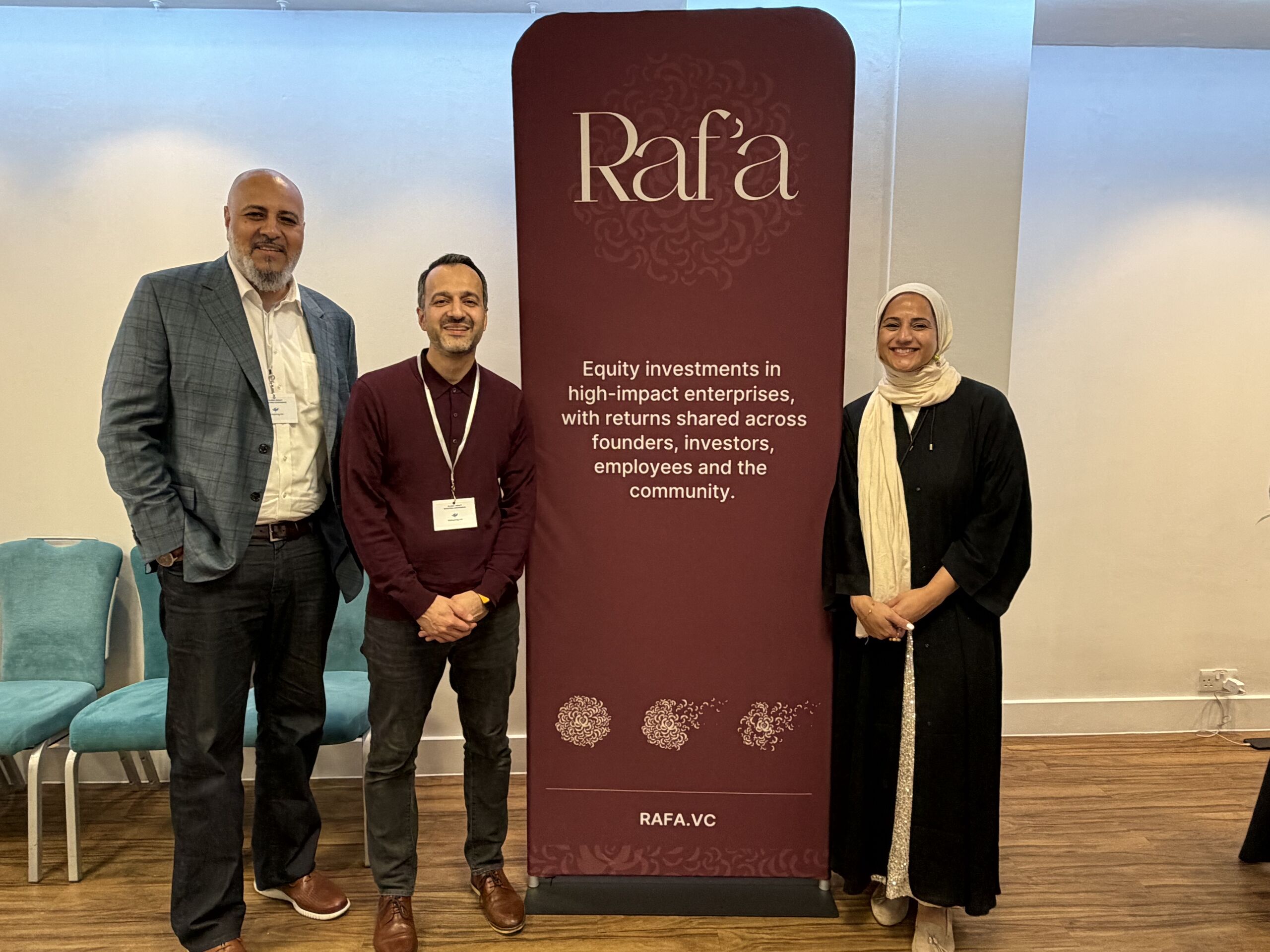
Raf’a is being developed by Sheeza Shah, Abdul Haseeb Basit and Umar Moghul, and is currently incubated at UpEffect, the organisation Shah has run for the past decade helping social enterprises raise values-aligned capital through crowdfunding. That work surfaced a deeper pattern: many alternative finance routes, including modern Islamic finance in practice, still replicate the extractive dynamics they were meant to challenge.
Raf’a responds to what its founders describe as a dual injustice. According to Raf’a, global majority and Muslim-led businesses receive less than 1% of venture capital funding. Many are pushed towards interest-bearing debt, or towards equity on terms that erode their ownership and control, such as preference shares and redemption clauses that put investor returns ahead of founder agency and community impact.
Raf’a grew out of an earlier project in partnership with Zebras Unite and Armillaria, the Islamic Capital Collective, which set out to develop a structured, participatory approach to redesigning capital systems to the creation of new capital products.. UpEffect’s work designing the Zebra Solidarity Fund for Zebras Unite, which set aside 2.5% of the co-op’s revenue, echoing the Islamic principle of Zakat, became an early proof point that these principles could be built into a live financial vehicle. Raf’a is now being developed with grant and ongoing support through the Joseph Rowntree Foundation’s Wealth Hackers Initiative. .
Most attempts to bring Islamic finance into the mainstream have focused on products: Islamic banks, Islamic fintechs, Shariah-compliant funds sitting alongside conventional ones. Raf’a starts from a different place, asking whether the fund itself (its ownership, governance and distribution of returns) needs to be redesigned from first principles.
The team draws on Islamic finance principles that challenge extractive capital logic: no interest or exploitation, shared risk and reward tied to contribution, investment linked to real economic activity, avoidance of harmful sectors, wealth redistribution, and a view of wealth as a trust rather than private entitlement. In practice, Raf’a will offer Shariah-aligned equity with no coercive redemption terms, invested patiently in profitable and near-profitable SMEs working on social, climate and economic justice. The fund is evergreen, with no fixed end date, so founders aren’t pushed towards an early sale.
As Shah is careful to stress, this isn’t a fund for Muslim investors only. She sees it as a broader design language: “Raf’a is not just for Muslims, it’s intended for everyone that aligns with our thesis. That was the mistake, I think, that a lot of the Islamic finance industry made. It became a Muslim-centric industry when Islamic finance was meant to be for everyone.”
A structure that shares value beyond investors
In place of the preferential rights that usually concentrate power with investors, Raf’a’s proposed structure spreads value across investors, fund stewards, founders, employees and local communities. Founders are encouraged to keep ownership of their businesses, so that a business’s success reaches the people around it..
A community endowment
Raf’a intends to commit 2.5% of fund returns to a community endowment, which will make grants to aligned social enterprises and help them become investment-ready. As the fund generates returns, a share of that value will flow back into the ecosystem. Raf’a also expects to invite others to contribute, so the endowment can grow beyond its own contribution into a broader community asset.
Shaped by the people it serves
Shah wants the people Raf’a serves to shape it: “we don’t want to decide things based on assumptions that we have as stewards. We really want to make sure that the community has input on how Raf’a can benefit everyone.”
Raf’a is working in a field with few close precedents, despite the size of the Islamic finance sector. Much of the modern industry has developed by adapting conventional financial products to meet Shariah requirements. Raf’a is going back to the underlying principles instead: shared risk and reward, the social purpose of wealth, and the responsibilities that come with ownership. That makes its approach more foundational, and leaves the team with few established models to work from.
As Shah puts it, the task is to explore more fully what those principles require in practice: “We as a community need to do better.”
Raf’a is testing the model with prospective funders, portfolio founders and community stakeholders. It is also fundraising, and seeking anchor investment from aligned LPs who support a Shariah-compliant equity fund.
Raf’a reflects a wider shift across this guide: capital treated as a system that can be intentionally designed, as well as money to deploy. Its principles draw on ethical traditions that have long asked how finance can share risk, avoid harm and stay accountable to people and planet, now applied to today’s purpose-led businesses. The question is moving from how we fund better businesses to how we build better ways of funding.